
Chapter 2: Grief in Dissonance
“The aim of art is to represent not the outward appearance of things, but their inward significance.” – Aristotle
Before I ever held a camera, I held glue sticks, safety scissors, and construction paper in classrooms full of children learning how to exist in the world. As a special education teacher, I was trained to prioritize process over outcome. I did not care whether a child arrived at the correct answer, stayed inside the lines, or produced something neat and uniform. I cared whether they tried, whether they experimented, whether they stayed engaged long enough to discover something about themselves. A crooked cut or misspelled word was not failure. It was evidence of effort, curiosity, and growth. The process was where learning lived, where confidence formed, and where transformation actually occurred. The product was simply a snapshot of a much larger, more important journey.
When I left teaching, I did not realize that photography would become a continuation of that same philosophy, but turned inside out. For me, astrophotography as a therapeutic practice, a way of alchemizing grief into light, wonder, and meaning. Standing alone under the night sky, tracking stars across hours, breathing through cold and silence, I learned that the act of photographing itself became the medicine. The stillness, patience, solitude, and presence required by the process mirrored the inner work of grief. Yet unlike the classroom, where process was honored and product was secondary, photography offers the opposite experience. The world sees only the finished image. The process disappears entirely except to the creator- the artist.
There are images I’ve taken during periods of devastating loss- loss of safety, loss of love, loss of identity- that people tell me are peaceful, grounding, even transcendent. And yet when I look at those same photographs, my body reacts first. Pain flares. My chest tightens. My stomach drops. I don’t see stars or landscapes or trees, I see the moment I was standing there, what I was carrying, what I was surviving.
This creates a strange dissonance- the process of astrophotography versus the product that’s admired. I may be experiencing tremendous loss while creating a photograph that appears peaceful, beautiful, or transcendent. A viewer encounters the product or image in a gallery, on a website, or in a frame on their wall, untethered from the moment it was made. They are free to feel calm, awe, inspiration, or joy. Meanwhile, my body remembers something else entirely. I remember exhaustion, fear, heartbreak, loneliness, uncertainty, or grief. When I look at certain photographs, I do not first see composition or light. I feel what I felt when I pressed the shutter. The image becomes not a visual object, but a somatic memory. The product travels outward. The process remains in my nervous system.
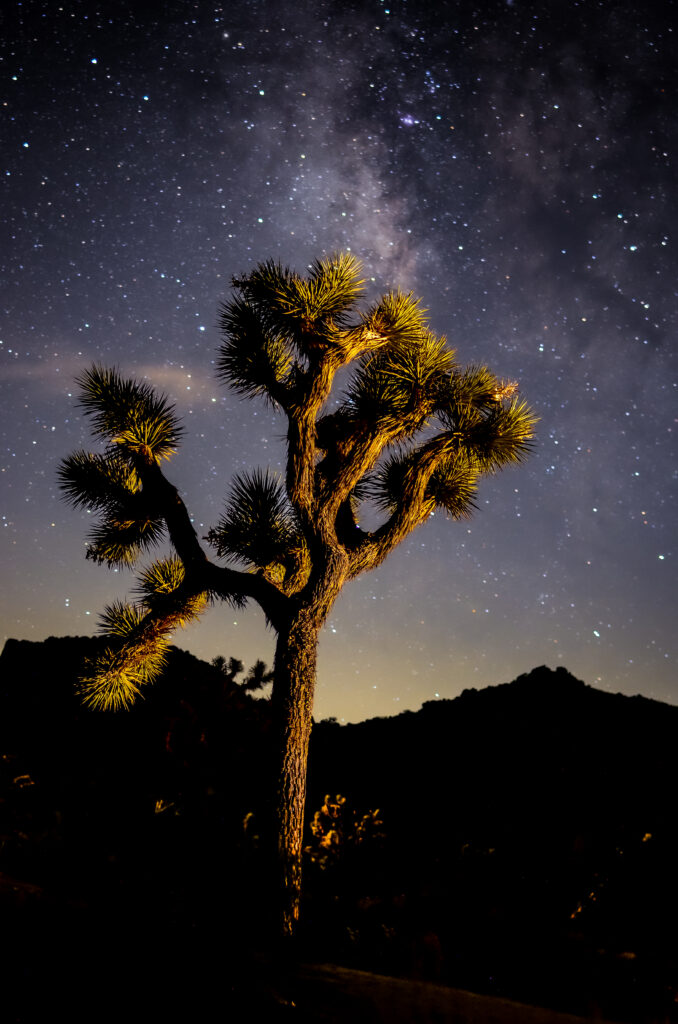
One of my most recognized photographs is of a Joshua tree. To many people, it is simply a striking desert portrait, resilient, elegant, iconic. But to me, that image is terrifying. I took it while in a compromising situation with my ex, deep in a national park with no phone service. At one point, I fainted and dropped to the ground. When I regained consciousness, I was disoriented, scared, and overwhelmed with relief that I was alive. The desert felt vast and indifferent. The sky offered no comfort. The tree stood there anyway. Every time I see that photograph, my body remembers the fear before my mind remembers the beauty. I will learn several months later after it happened in other scenarios that this was a vasovagal syncope which is an overwhelm to the nervous system and it caused a blackout. Basically a trauma response that leaves you unconscious and terrified in the desert.
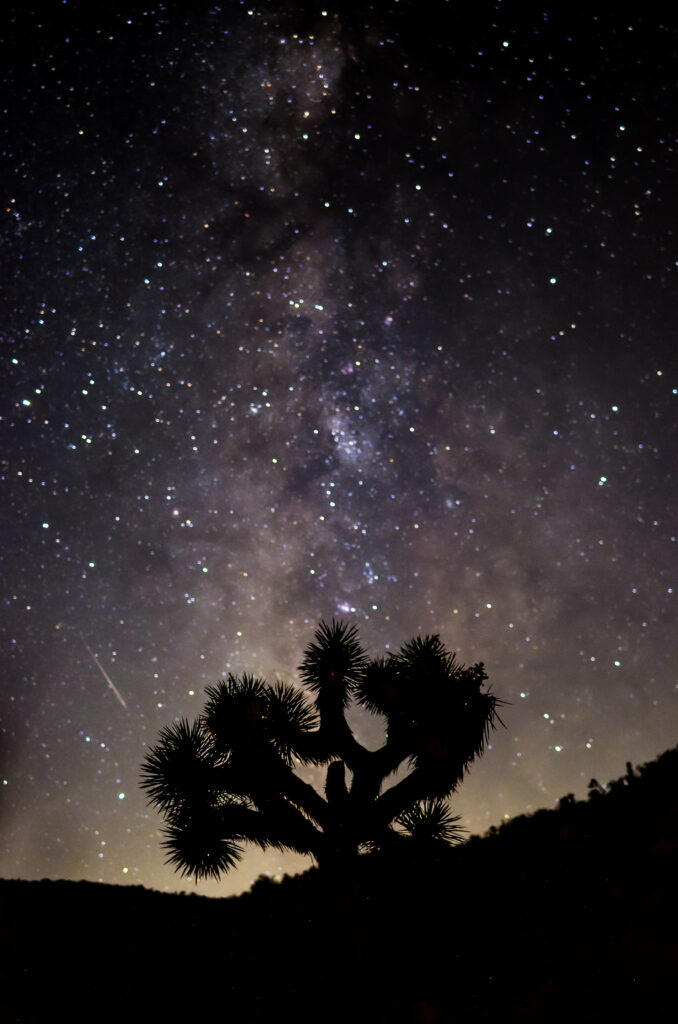
That Joshua tree has since become a symbol for me, not just of beauty, but of malleability. Yucca trees grow twisted and contorted because of relentless wind, harsh sun, and barren soil. Their shape is not accidental. It is a physical record of adaptation to inhospitable conditions. They are beautiful not despite their struggle, but because of it. In fact they are thriving in the harsh, desolate climate of the desert. That night in the desert, I was being shaped too, by circumstances I did not choose, by fear I did not expect, by survival instincts I did not know I carried. The photograph holds that story, even if no one else sees it. The product looks serene. The process was anything but.
This gap between what an image means to its maker and what it offers to its audience is the heart of my work. Viewers bring their own stories, histories, projections, and emotional needs to each photograph. They may feel peace where I felt terror, awe where I felt grief, grounding where I felt loss. Neither experience is wrong. But they exist on entirely different planes. The product is portable, legible, and shareable. The process is private, embodied, and often unspeakable. In this way, photography becomes a profound study in dissonance. Beauty can emerge from devastation. Calm can be born from chaos. Light can be captured in moments that feel internally dark.
This project lives precisely in that tension. It is not just about what the photographs look like as a product, but what they cost in the process. It is about honoring the grief, fear, longing, and survival embedded in the making, not just admiring the beauty of the made thing. It is about recognizing that art often functions as emotional alchemy, transforming pain into something luminous without erasing the pain itself. In grief, as in photography, process is where the real work happens. Product is simply the visible residue of an invisible becoming. And sometimes the most important story is not what you see, but what the artist had to survive in order to show it to you.