
If someone had told me years ago that I’d one day photograph the northern lights from Colorado (multiple times) I probably would’ve laughed. Yet somehow, the Sun (and the night) keeps surprising us. And every now and then, the aurora reaches far enough south to brush our mountains and plains with color.
Over the past several years, I’ve had the rare privilege of standing under the aurora across Colorado:
-
-
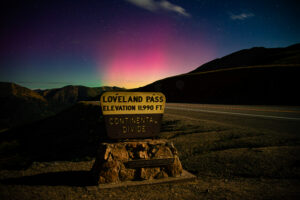
Fall 2023 – Loveland Pass: my first true taste of pillar curtains over the Continental Divide.
-
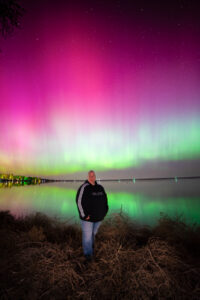
May 2024 – Jackson Lake State Park: the strongest storm of my life, where the sky pulsed so intensely I set the world record in Goosebumps.
-
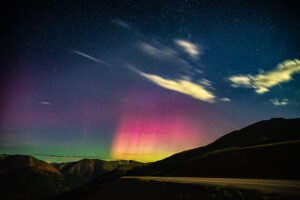
October 2024 – Guanella Pass: in and out of clouds with colors shooting even to the south.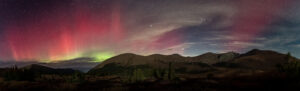
-
November 2025 – near Red Rocks: a clear display even through the city light pollution with unmistakable bands of color rising above the foothills.
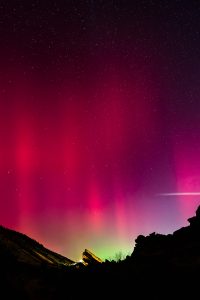
Each event felt impossible in its own way. But nothing compares to May 2024.
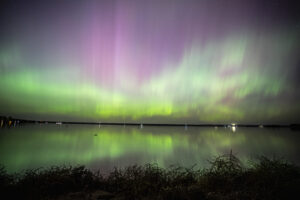
That night, at Jackson Lake, I’d just finished reading Andrea Gibson’s poem “Acceptance Speech After Setting the World Record in Goosebumps.” The timing felt cosmic- my skin was already electric before the geomagnetic storm even peaked. Then the sky erupted. Columns of magenta and green shot upward, shimmering so fast it felt like the world was breathing light. I am certain I broke the world record for goosebumps provoked by awe. The sky pulsed as if it were breathing- it was truly alive. This night was kismet for me as I was accepted into an art gallery in Ft Morgan and the hosts had asked me if I had any images that were local. At the time I didn’t, but this display of lights reflecting off of a perfectly still lake gave me the perfect collection to add to my portfolio for this art opening.
I’ll never forget it. This piece is titled “Goosebumps after this poem”

Understanding the Colors: SAR Arc Red, Greens, and Yellows
Most people know the aurora for its greens, maybe its pinks. But one of the most mysterious and misunderstood features is the SAR arc- short for Stable Auroral Red arc.
The Red SAR Arc
-
Color: Deep crimson to cherry red.

-
Cause: Emission from oxygen atoms at ~630.0 nm at high altitudes (typically 250–400 km above Earth).
-
Why it matters: This red arc isn’t the same as the vibrant “curtains” we often think of. SAR arcs form during strong geomagnetic disturbances and stretch in a smooth, wide band across the sky.
-
Why Colorado sees it: At mid-latitudes, we are often too far south to see the main auroral oval overhead. But the SAR arc extends much farther, making it one of the most common features observed here when storms get strong enough.
In short: if you see a smooth, red band spanning the sky, it’s often the SAR arc.
Green and Yellow Hues
These colors show up during stronger auroral events.
-
Green: The classic aurora. It comes from oxygen atoms about 100–150 km up.
-
Yellow/Pale Gold: This is usually a blend of green oxygen emission with red (either SAR or higher-altitude red aurora).
-
Why they appear in Colorado: When the Kp index climbs high enough, the auroral oval expands south. Instead of seeing the aurora far on the northern horizon, we begin to see structure- beams, pillars, and sometimes the beginnings of curtains.
The May 2024 storm brought all of it: red, green, yellow, and patterns in the sky that normally belong far closer to the Arctic Circle.
Where to Look From Colorado
If the aurora is forecast for mid-latitudes, here’s how to orient yourself:
-
Direction:
-
Almost always look north first.
-
If the storm is extremely strong, the lights can stretch overhead or even to the south- but that only happens during rare, record-level geomagnetic events.
-
-
Elevation helps:
-
Mountain passes, wide-open plains, and anywhere with a clear view of the northern horizon can make all the difference. Getting as far north as possible is also helpful when scouting locations.
-
-
Dark skies matter:
-
Light pollution washes out the vibrancy of the colors.
-
State/Dark Sky parks, high-alpine passes, and the eastern plains are some of Colorado’s best vantage points.
-
Apps and Tools for Tracking the Aurora
Here are the most reliable tools for predicting and photographing auroras from Colorado:
Aurora Prediction Apps
1. AURORA (iOS/Android)
My personal favorite. Shows:
-
Real-time Kp index
-
Localized probability of visibility
-
Cloud cover forecasts
-
Push notifications during storms
2. Space Weather Live
Great for deeper data:
-
Solar wind speed
-
Bz orientation (the most important factor for mid-latitudes)
-
Real-time oval expansion maps
3. My Aurora Forecast
Beginner-friendly and good for quick checks.
Includes alerts, short-term predictions, and visibility charts.
4. NOAA SWPC (Space Weather Prediction Center)
The gold standard for official data:
-
Geomagnetic storm alerts
-
Auroral oval maps
-
3-day forecasts
Satellite & Data Tools for Serious Chasers
• DSCOVR / ACE (via SpaceWeatherLive or NOAA)
Shows upstream solar wind data—critical for knowing if a storm is strengthening or weakening.
• KP Earth Viewer / OVATION Maps
Real-time visualization of where the aurora oval is positioned relative to your location.
• Windy
For watching cloud cover in real time before heading out.
📍 Where to Put Your Location
Most aurora apps let you set a home location.
For Colorado, set:
-
Latitude ~40°N (general area)
-
Or your specific town/city for precise probability estimates
-
For photography trips, set alternate locations like “Loveland Pass,” “Jackson Lake State Park,” or “Guanella Pass”
This helps tune the predictions for mid-latitude visibility.
Final Thoughts
There’s something uniquely humbling about watching the northern lights from Colorado. Maybe it’s because we’re not supposed to see them here- at least not often. The rarity makes each appearance feel awe- which Andrea Gibson tells us is the antidote to despair.
And on that night in May 2024, standing on the quiet shore of Jackson Lake with Andrea Gibson’s words still ringing through me, it felt like the sky was giving an acceptance speech of its own- one written in a dance between electromagnetic breath, the visual spectrum, and biology.
If you ever get the chance to see the aurora from Colorado, take it.
Take the midnight drive, grab the camera, stand in the cold wind.
When the sky decides to speak, it’s worth listening.